
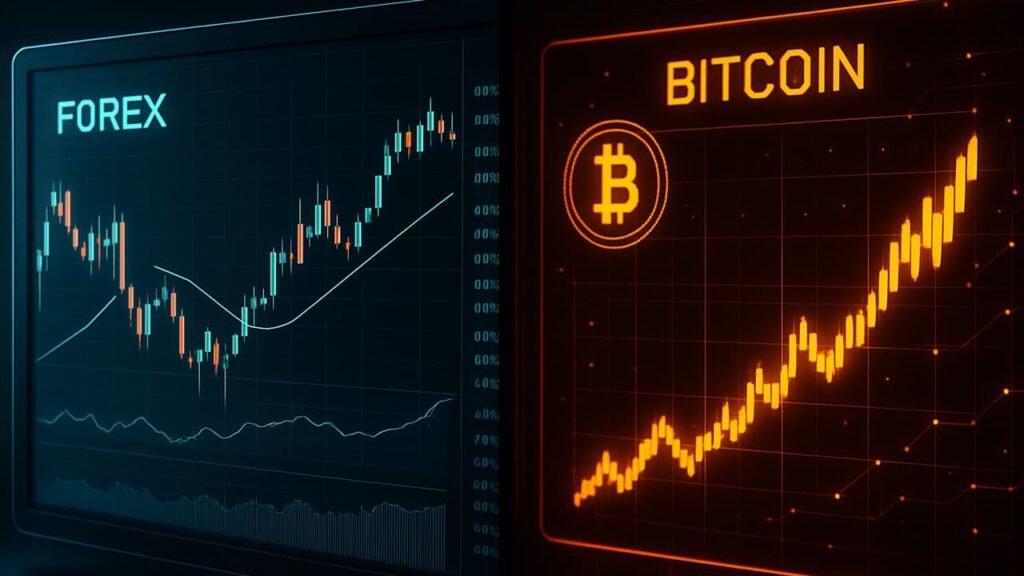
In today’s digital economy, two of the most popular online trading markets are foreign exchange (forex) and cryptocurrency. Both allow traders to profit from currency price movements — whether through traditional government-issued currencies or digital coins.
But which market offers the better investment opportunity in 2025? Let’s compare their similarities, differences, and which might suit your goals best.
Forex vs. Cryptocurrency: The Similarities
- 24-Hour Markets
Both markets operate around the clock.
- Forex trades 24 hours a day, five days a week.
- Cryptocurrency trades 24/7, with no downtime.
This flexibility allows traders across different time zones to participate whenever market conditions suit them.
- Decentralized Trading
Neither market is centralized under a single global exchange.
- Forex operates over the counter (OTC), involving banks, institutions, and brokers.
- Cryptocurrencies trade across decentralized blockchain networks and multiple exchanges worldwide.
- High Liquidity in Major Assets
Both markets offer deep liquidity in leading instruments.
- In forex, pairs like EUR/USD or USD/JPY dominate.
- In crypto, Bitcoin (BTC) and Ethereum (ETH) account for the majority of trading volume.
- Volatility
Price volatility is a defining feature of both markets, though to different degrees.
- Forex tends to be less volatile, with daily movements often within 1 %.
- Crypto can swing 5–10 % or more within hours, creating both opportunity and risk.
- Use of Leverage
Leverage is available in both markets, allowing traders to control larger positions with smaller capital.
However, leverage amplifies both profits and losses, so risk management is critical.
Forex vs. Cryptocurrency: The Differences
- Market Structure
- Forex: Involves trading fiat currencies such as the U.S. dollar (USD), euro (EUR), British pound (GBP), and Japanese yen (JPY). Transactions are conducted through brokers and financial institutions.
- Cryptocurrency: Involves digital assets like Bitcoin (BTC), Ethereum (ETH), and Solana (SOL), traded through exchanges such as Binance, Coinbase, or Kraken.
- Regulation
- Forex: Highly regulated worldwide. Authorities like the U.K. Financial Conduct Authority (FCA), U.S. Commodity Futures Trading Commission (CFTC), and European Securities and Markets Authority (ESMA) oversee broker conduct and protect traders.
- Cryptocurrency: Regulation remains fragmented. Some regions have adopted comprehensive frameworks (e.g., MiCA 2025 in the EU), while others still lack clear oversight. This creates greater risk but also potential freedom for innovation.
- Ownership
- Forex: Traders do not own the underlying currencies; they speculate on exchange-rate changes to earn profits.
- Crypto: Buyers own the digital assets themselves, stored in digital wallets. They can hold, trade, stake, or use them for decentralized-finance (DeFi) applications.
- Entry Barriers
- Forex: Requires opening a brokerage account and often a minimum deposit. Understanding leverage, margin, and spreads is essential.
- Crypto: Easier to access — you can start with small amounts and even purchase fractional coins (e.g., 0.001 BTC).
- Market Maturity
- Forex: A decades-old, well-established market valued at more than $7.5 trillion in daily turnover.
- Cryptocurrency: A newer, rapidly evolving market still experiencing regulatory, technological, and liquidity growing pains.
Which Is the Better Online Investment in 2025?
Forex: Stability and Liquidity
- Pros: Deep liquidity, high regulation, predictable trends, and lower volatility.
- Best for: Traders seeking consistent returns in a mature, transparent environment.
Cryptocurrency: Innovation and Potential Growth
- Pros: High volatility means the potential for outsized gains. The 2025 crypto rally — driven by tokenized assets, Bitcoin ETFs, and AI-integrated blockchain projects — has reignited interest.
- Best for: Investors willing to accept risk in exchange for high-growth opportunities.
Choosing the Right Market for You
| Factor | Forex | Cryptocurrency |
| Market Hours | 24 h, 5 days/week | 24 h, 7 days/week |
| Volatility | Low to moderate | High |
| Regulation | Strong global oversight | Developing / inconsistent |
| Liquidity | Extremely high | High in top coins, lower in others |
| Risk Level | Moderate | High |
| Best for | Stability, institutional backing | Innovation, growth potential |
Ultimately, the “better” investment depends on your risk tolerance, trading experience, and financial goals. Some investors even choose to diversify — trading forex for steady returns and holding cryptocurrencies for long-term growth.
The Bottom Line
Both forex and cryptocurrency markets provide exciting online investment opportunities in 2025.
- Forex offers structure, stability, and high liquidity.
- Crypto delivers innovation, flexibility, and the potential for exponential returns.
The smart approach? Diversify — use forex to build consistent income and crypto to capture emerging opportunities.
Stay informed with Für-Trade’s weekly market updates. Subscribe now for curated news, expert strategies, and global investment insights.