
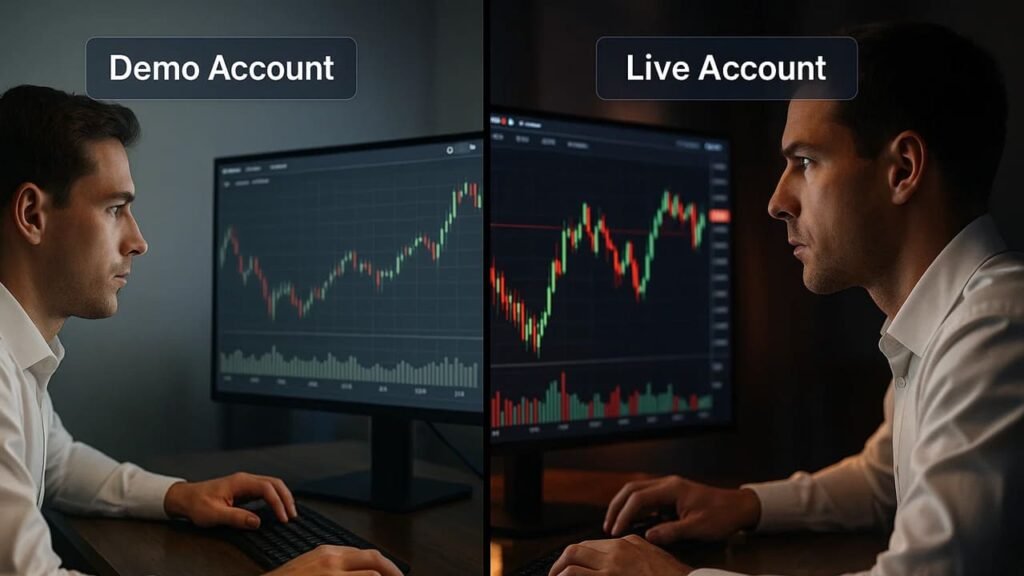
Every trader starts with the same question: When am I ready to move from a demo account to live trading?
Practicing on a demo account is an essential step for every beginner — it allows you to learn how the market works, test strategies, and gain confidence without financial risk. But at some point, to truly grow as a trader, you’ll need to make the switch to a live account where real emotions and real money are involved.
This article explores the key differences between demo and live trading, the benefits of each, and how to know when it’s time to take the next step confidently.
- What Is Demo Trading?
A demo account is a simulation of real market conditions provided by brokers, where you trade with virtual money instead of real funds.
It mirrors live trading platforms, offering the same features, price movements, and tools — but without the financial consequences of losses or rewards of profits.
Main Benefits of Demo Trading:
- Risk-Free Learning: Practice strategies without losing money.
- Familiarization: Learn how to use trading platforms, execute orders, and manage charts.
- Strategy Testing: Try different approaches to find what fits your style.
- Confidence Building: Helps beginners understand how markets react to different events.
Tip: Treat your demo account like a real one — trade with the same discipline and capital size you plan to use later.
- What Is Live Trading?
Live trading involves using your own money in real market conditions. It introduces one factor that no demo account can replicate: emotion.
With live trading, every profit feels rewarding — and every loss feels personal. The pressure of real money changes decision-making, discipline, and emotional control.
Key Characteristics of Live Trading:
- Real Market Execution: Includes slippage, variable spreads, and transaction costs.
- Emotional Impact: Winning or losing real funds affects psychology.
- Capital Management: Real money requires strict risk control and discipline.
- The Key Differences Between Demo and Live Trading
| Aspect | Demo Trading | Live Trading |
| Funds Used | Virtual money | Real capital |
| Emotions | No real stress or fear | Real emotions influence decisions |
| Execution | Instant, ideal conditions | Subject to slippage, spreads, and liquidity |
| Risk | None — purely educational | Real financial risk |
| Psychology | Easier to stay calm and logical | Emotions often override logic |
| Goal | Learning and testing | Earning and managing capital |
Pro Insight: Many traders perform well on demo but struggle on live accounts because they underestimate the psychological impact of trading real money.
- How to Know You’re Ready to Go Live
There’s no fixed timeline — it depends on your progress, consistency, and mindset. However, most successful traders make the switch only after meeting a few key conditions.
✅ 1. You’ve Mastered the Basics
You should be confident in how to place trades, use stop-losses, set take-profits, and calculate position sizes.
✅ 2. You Have a Profitable Strategy
Before going live, your demo trading results should show consistent profitability over a period of at least 2–3 months. Random wins aren’t enough — consistency matters more.
✅ 3. You Understand Risk Management
You know how to manage leverage, limit losses, and control risk per trade (usually no more than 1–2% of your account balance).
✅ 4. You’re Emotionally Ready
You’ve practiced staying calm during losses and disciplined during wins. If you find yourself emotional even in demo trading, you’ll need more time before going live.
✅ 5. You Treat Trading Like a Business
You have a trading plan, a journal to track performance, and a clear set of rules for entry and exit — not impulsive decisions.
- Common Mistakes When Switching Too Early
- Overconfidence:
Performing well in demo mode can create false confidence. Real-money trading is emotionally different. - Ignoring Emotions:
Underestimating how fear or greed will influence your real trades can lead to poor decision-making. - Risking Too Much:
New live traders often increase position sizes quickly. Start small to limit psychological pressure. - Abandoning the Plan:
Many traders throw away their demo-tested strategy after a few losses. Stick to your plan and review performance over time. - Neglecting Fees and Spreads:
Demo accounts often ignore transaction costs, but in live trading, spreads and commissions affect results.
- Best Practices for a Smooth Transition
If you’re ready to move to live trading, these tips will help you make the transition safely and effectively.
- Start Small
Begin with a small amount of capital — only what you can afford to lose. This reduces stress and helps you focus on execution.
- Use the Same Strategy You Practiced
Don’t change your trading style immediately after going live. Stick with what worked on demo and adjust gradually.
- Manage Emotions Actively
Expect to feel pressure or fear at first. Use stop-loss orders and proper risk management to stay disciplined.
- Keep a Trading Journal
Track every trade, your reasoning, and your emotional state. Reviewing this regularly will highlight patterns in both your performance and psychology.
- Keep Learning
Live trading will reveal weaknesses in your strategy that demo trading never exposed. Treat early mistakes as valuable lessons.
- When NOT to Switch to Live Trading
You should avoid going live if:
- You’re trading inconsistently on demo.
- You don’t yet understand how margin or leverage works.
- You haven’t experienced large drawdowns or emotional losses in demo.
- You expect instant profits or have unrealistic goals.
Pro Tip: Trading isn’t a race. The longer you take to build a strong foundation in demo mode, the better you’ll perform once you trade live.
- How to Bridge the Gap Between Demo and Live
Some brokers offer micro or cent accounts — a great middle step. These accounts use real money but allow trading in very small amounts (e.g., cents instead of dollars).
They’re perfect for testing emotional control under real conditions with minimal financial risk.
The Bottom Line
Demo trading is your training ground; live trading is where the real test begins.
Switching too early can lead to costly mistakes, but waiting too long can delay your growth.
The right time to move from demo to live trading is when you’ve developed consistent results, a disciplined mindset, and a clear understanding of your risk tolerance.
When you treat trading as a skill and a business, the transition becomes smoother — and your chances of success increase significantly.
Ready to take your trading to the next level? Subscribe to the Für-Trade newsletter for weekly education, expert insights, and step-by-step guidance to transition from demo to live trading successfully.