
Every successful trader — whether in forex, stocks, or commodities — has one thing in common: they know how to protect their capital. And one of the most important tools for doing so is the stop-loss order.
A stop-loss is your safety net in volatile markets. It helps you limit losses, manage risk, and trade with confidence, knowing that emotions won’t take control when prices move unexpectedly.
Let’s break down what a stop-loss is, how it works, and why every trader — beginner or professional — should use one.
- What Is a Stop-Loss?
A stop-loss order is a pre-set instruction you give your broker to automatically close a trade when the price reaches a specific level — usually one that limits your potential loss.
In simple terms:
A stop-loss is your “exit plan” for when the market moves against you.
Example:
If you buy EUR/USD at 1.1000 and set a stop-loss at 1.0950, your trade will automatically close if the price drops to 1.0950, limiting your loss to 50 pips.
Without a stop-loss, you risk holding onto losing trades for too long — often until small losses become large, damaging your overall portfolio.
- How Does a Stop-Loss Work?
When the market hits your stop-loss price, your broker automatically executes a market order (or sometimes a limit order, depending on your settings) to close your position at the next available price.
Stop-loss orders can be applied to buy or sell trades:
- If you’re buying (going long), your stop-loss is placed below your entry price.
- If you’re selling (going short), your stop-loss is placed above your entry price.
This ensures your downside is capped, no matter how volatile the market becomes.
- The Main Types of Stop-Loss Orders
Different types of stop-losses allow you to adapt your risk management to your trading style.
- Fixed Stop-Loss
A fixed stop-loss remains at the same price once set. It’s ideal for beginners who want a straightforward approach to risk control.
Example: Setting a 50-pip stop on every trade regardless of market volatility.
- Trailing Stop-Loss
A trailing stop automatically moves with the market in your favor but stays in place if the market turns against you.
Example: If you buy EUR/USD at 1.1000 with a 50-pip trailing stop, and the price rises to 1.1050, your stop-loss automatically moves to 1.1000 — locking in profit while limiting loss if the trend reverses.
- Guaranteed Stop-Loss
Some regulated brokers offer guaranteed stop-loss orders (GSLOs), which ensure your position closes exactly at your chosen price, even during high volatility or price gaps.
They often come with a small premium fee but are especially useful during major news events.
- Why Every Trader Needs a Stop-Loss
- It Protects Your Capital
The number one rule in trading is: protect what you have before you chase profits.
Stop-losses prevent small mistakes or market surprises from wiping out your account.
- It Removes Emotion from Trading
Fear and hope are powerful emotions that can lead traders to make impulsive decisions. A stop-loss automates discipline — it executes your plan even when your emotions tell you to “wait a little longer.”
- It Helps You Define Risk
Every trade should have a risk-to-reward ratio. Setting a stop-loss helps you calculate potential losses before entering a trade.
Example: risking $100 to potentially gain $300 is a 1:3 risk/reward ratio, which is a common benchmark among professional traders.
- It Prevents Large Drawdowns
Without a stop-loss, a single bad trade can destroy weeks or months of gains. Using one ensures that no single trade can drastically damage your capital.
- It Builds Consistency
Successful trading isn’t about winning every trade — it’s about managing losses effectively and letting your winners grow. Stop-losses keep your results consistent and predictable over time.
- How to Set an Effective Stop-Loss
Setting a stop-loss is part science, part strategy. Too tight, and you’ll be stopped out prematurely; too wide, and you risk losing more than necessary.
Here are some practical methods to find the right balance:
- Technical Levels
Place your stop-loss near key support or resistance levels — areas where price action has previously reversed.
- Volatility-Based Stop
Use market volatility (measured by indicators like ATR – Average True Range) to adjust your stop distance. High volatility requires wider stops; low volatility allows tighter stops.
- Percentage of Account
Many traders risk 1–2% of their total balance per trade. This ensures that even a string of losses won’t wipe out your account.
- Timeframe Consideration
Longer timeframes (like 4-hour or daily charts) typically require wider stops because price fluctuations are larger than on shorter timeframes.
Tip: Always place your stop-loss based on market logic, not just on how much you “feel” comfortable losing.
- Common Mistakes to Avoid
- ❌ Not Using a Stop-Loss at All – The biggest mistake traders make.
- ❌ Moving Your Stop-Loss Further Away – A sign of emotional trading; it increases your risk unnecessarily.
- ❌ Placing It Too Tight – The market needs room to breathe; overly tight stops can trigger premature exits.
- ❌ Ignoring News Events – Sudden volatility can trigger stops. Plan around high-impact economic announcements.
- Example of a Stop-Loss in Action
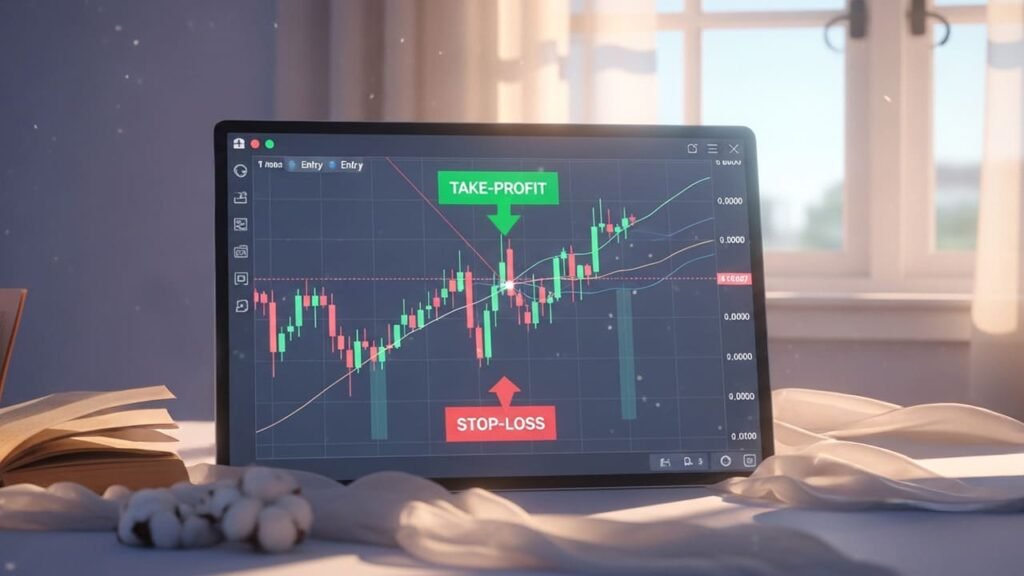
Let’s say you buy GBP/USD at 1.2500, with a stop-loss at 1.2450 and a take-profit at 1.2600.
- If the price rises to 1.2600 → your trade closes for a +100 pip gain.
- If the price falls to 1.2450 → your trade closes automatically with a –50 pip loss.
You’ve lost only what you were prepared to risk and avoided emotional decision-making.
- Combining Stop-Loss with Take-Profit
To build a complete trade plan, pair your stop-loss with a take-profit order, which automatically closes your trade when your target profit is reached.
This creates a balanced approach:
- Stop-loss = protects your downside.
- Take-profit = locks in your upside.
Together, they form the foundation of effective risk management.
The Bottom Line
A stop-loss isn’t just a tool — it’s your trading insurance policy. It ensures that one bad trade doesn’t become a financial disaster and allows you to focus on consistency, not luck.
Every trader — beginner or expert — should treat the stop-loss as a non-negotiable part of every trade. It’s the difference between trading with discipline and trading with hope.
Want to master risk management and protect your profits? Subscribe to the Für-Trade newsletter for weekly insights on trading psychology, strategy, and market updates.