
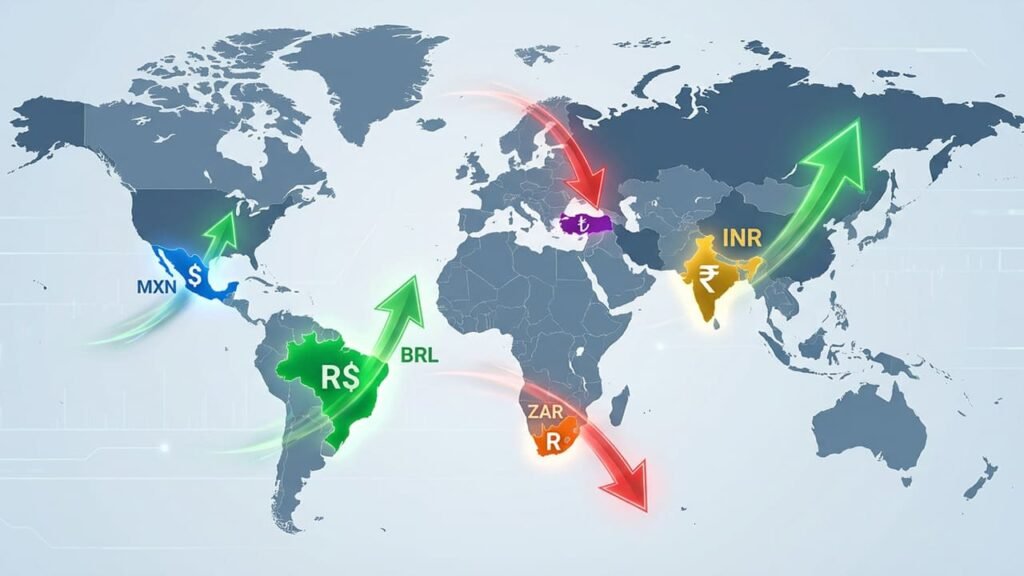
Emerging markets (EMs) offer high-risk, high-reward trading opportunities for forex traders. As economies develop, they can provide strong growth potential — but this comes with increased volatility and uncertainty. Understanding the opportunities and risks of trading in these markets can help you maximize profits while managing risk effectively.
In this article, we’ll highlight the top five emerging markets for forex traders in 2026, with a focus on the factors that make these markets attractive, as well as the risks and strategies you should consider.
- The Indian Rupee (INR) – India
India’s economy is projected to continue growing rapidly into 2026, making the Indian Rupee (INR) an increasingly attractive currency for forex traders. As one of the world’s largest economies, India presents opportunities related to its growing tech sector, expanding consumer base, and increasing foreign investment.
Why Trade the Indian Rupee?
- Economic Growth: India is expected to be one of the fastest-growing major economies, driven by a young population and a growing middle class.
- Interest Rates: The Reserve Bank of India (RBI) tends to offer relatively higher interest rates compared to other emerging markets, making the INR attractive for carry trades.
- Digital and Financial Innovation: India’s push towards digital payments, fintech, and blockchain is further attracting international capital.
Risks:
- Geopolitical Tensions: Regional conflicts and political instability can lead to volatility.
- Inflation and Currency Fluctuations: The INR has historically been volatile against major currencies like the USD.
Pro Tip: Trade the INR against stable, low-yielding currencies like the USD or EUR to take advantage of higher interest rates.
- The Brazilian Real (BRL) – Brazil
Brazil has the largest economy in Latin America and is an attractive emerging market for forex traders. With its vast natural resources, strong agricultural exports, and growing industrial sectors, Brazil is poised for strong currency movements through 2026.
Why Trade the Brazilian Real?
- Commodity Exports: Brazil is one of the world’s largest exporters of soybeans, oil, and iron ore, which links the BRL to global commodity prices.
- Central Bank Policy: The Banco Central do Brasil frequently adjusts interest rates to stabilize inflation, offering trading opportunities around policy announcements.
- Political and Economic Reforms: Brazil is expected to implement key structural reforms, enhancing its long-term economic stability.
Risks:
- Political Instability: Brazil has faced political uncertainty in recent years, which can lead to volatility in the BRL.
- Inflation Risk: Brazil’s inflation rate can sometimes exceed expectations, affecting the value of the BRL.
Pro Tip: Trade BRL during periods of economic or commodity-related news that may affect price movements, and always monitor inflation data and political developments closely.
- The South African Rand (ZAR) – South Africa
South Africa, with its well-developed financial markets and diverse economy, is an attractive currency for traders looking for opportunities in Africa. The South African Rand (ZAR) is highly influenced by global commodity prices, particularly gold and platinum, making it a valuable currency to trade for commodity-linked strategies.
Why Trade the South African Rand?
- Commodity Exposure: South Africa is a key exporter of minerals and precious metals, with gold being a primary influence on the ZAR’s value.
- Interest Rates: The South African Reserve Bank (SARB) often sets interest rates higher than developed markets, providing attractive returns for carry traders.
- Emerging Market Growth: South Africa’s economy continues to recover, with significant infrastructure development and a focus on increasing exports.
Risks:
- Political Risk: South Africa faces challenges like political unrest and corruption, which can impact investor confidence.
- Global Economic Sensitivity: The ZAR is sensitive to changes in global risk sentiment, especially in commodity markets.
Pro Tip: Focus on trading the ZAR during global commodity rallies or periods of high volatility, such as during inflationary periods that affect metal prices.
- The Turkish Lira (TRY) – Turkey
Turkey, strategically positioned between Europe and Asia, remains an important emerging market for forex traders. Despite volatility, the Turkish Lira (TRY) offers opportunities for traders who understand the risks and factors driving its value.
Why Trade the Turkish Lira?
- High Interest Rates: The Turkish Central Bank has maintained high interest rates to combat inflation, making the TRY attractive for carry trades.
- Geopolitical Significance: Turkey plays a key role in regional geopolitical dynamics, which can cause significant movement in the TRY.
- Growing Economic Sectors: Key industries such as construction, manufacturing, and tourism make Turkey a prominent emerging market.
Risks:
- Inflation and Currency Depreciation: The TRY has experienced significant devaluation due to high inflation and central bank policy uncertainty.
- Political Instability: Tensions between Turkey and the West, as well as internal political challenges, can lead to volatility in the lira.
Pro Tip: Focus on trading the TRY during periods of strong economic news, such as interest rate decisions, and manage risk carefully due to the high volatility of the currency.
- The Mexican Peso (MXN) – Mexico
The Mexican Peso (MXN) has long been an attractive option for forex traders, particularly those looking for exposure to Latin America. Mexico’s proximity to the U.S., its manufacturing base, and its role in global trade make it a key currency to watch in 2026.
Why Trade the Mexican Peso?
- Trade Relations with the U.S.: As the second-largest trading partner of the U.S., Mexico’s economy is closely tied to U.S. economic performance, which affects the MXN’s value.
- Oil and Energy Exports: Mexico is an oil exporter, and oil price fluctuations can impact the strength of the peso.
- Low-Cost Economy: Mexico’s lower labor costs make it an attractive location for manufacturing and trade, further supporting the MXN.
Risks:
- Economic Dependence on the U.S.: The peso is heavily influenced by U.S. economic conditions, meaning shifts in U.S. policy or economic performance can dramatically affect the MXN.
- Political Risk: Mexico faces challenges such as corruption and political instability, which can create short-term volatility in the currency.
Pro Tip: Trade the MXN against the USD, especially during U.S. economic data releases or when oil prices change.
- Conclusion: Which Emerging Market Should You Focus On in 2026?
Choosing which emerging market to trade depends on your trading style, risk tolerance, and goals. Here’s a summary of the top emerging markets for 2026:
| Country | Currency | Attraction | Risk Factors |
| India | INR | Rapid economic growth, high yields | Geopolitical tensions, inflation |
| Brazil | BRL | Commodity exports, rate differentials | Political instability, inflation risk |
| South Africa | ZAR | Commodity-driven, high interest rates | Political risk, reliance on global demand |
| Turkey | TRY | Geopolitical influence, high interest rates | Inflation, political volatility |
| Mexico | MXN | U.S. trade relationship, oil exports | U.S. dependency, political instability |
Each of these currencies offers unique trading opportunities based on global economic trends and regional developments. However, they also carry specific risks that need to be carefully managed, especially in volatile times.
Ready to trade the emerging markets of 2026? Join the Für-Trade newsletter for weekly updates on the best forex opportunities, strategies, and risk management tips tailored to emerging markets.